The Power of Why

Why the smallest question can make the biggest difference to an English Literature essay.
Apparently, Simon Sinek has made an entire career out of asking one very small question: Why? His bestselling book, Start With Why, argues that understanding the purpose behind what we do is rather more important than simply knowing what we do. An excellent principle, although generations of exasperated parents might have something to say about its application at the breakfast table. Personally, I used to revel in the increasingly outlandish answers I'd invent for my niece and nephew when they were toddlers. Whether this contributed anything to their intellectual development is debatable. It certainly entertained me.
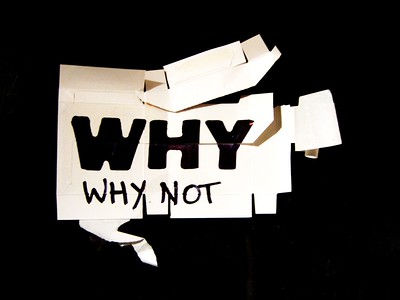
Following a recent post on the subject, former colleague and Theory of Knowledge guru Daniel Trump pointed me towards Sinek's work - About — ToK Today. It occurred to me that this is precisely the question I spend a considerable proportion of my working life encouraging students to ask. Not because I'm particularly difficult (although opinions may vary), but because why is often the difference between a perfectly competent English Literature essay and a genuinely perceptive one.
The Great Literary Device Hunt
English students are remarkably good at spotting things: metaphors, similes, dramatic irony, alliteration. Some can identify a semantic field at twenty paces. Give them a Shakespearean soliloquy and they'll have it covered in highlighter before you've finished making the coffee.
The trouble begins when spotting the technique becomes the purpose of the exercise. It's bad enough in drama, creeps insidiously into anthology poetry and reaches epidemic proportions in unseen analysis. The poet uses a metaphor. The metaphor creates an effect. The effect makes the reader feel something (or, shudder, highlights something). Next paragraph, please.
It's analysis by assembly line. Everything is technically present, but nobody seems particularly interested in what it all means. Least of all, I would suggest, the examiner. I speak from experience.
Take Othello (and why wouldn't you?). A student might tell me that Shakespeare uses dramatic irony because the audience knows Iago is lying while Othello remains blissfully unaware. Fair enough. But why does Shakespeare put us in that position? Why must we sit there, powerless, watching an intelligent man enthusiastically dismantle his own life on the advice of someone we know to be a spectacularly bad friend? Rather more disturbingly, why do we enjoy being taken into Iago's confidence?
Now things are getting interesting. We're no longer simply identifying dramatic irony. We're considering what Shakespeare makes us experience, and what that experience might reveal about trust, manipulation and our rather touching belief in our own good judgement. As in Shakespeare's England, so today. Human beings remain reassuringly, or perhaps alarmingly, predictable.
The Curious Incident of the Missing Marks
This becomes particularly important when students move from GCSE to A Level or IB English. Many have spent years doing exactly what they've been taught to do: identify techniques, embed quotations, explain effects and produce beautifully organised paragraphs. Then, rather rudely, the marks stop climbing. The dreaded flight path stalls (I do hate a flight path.)
The feedback arrives, usually scrawled in the margins. More depth needed. Develop your analysis. Explore alternative interpretations. All sound advice, providing someone has explained what on earth that actually involves. Usually, the student doesn't need another technique to identify or another quotation to memorise. They need to interrogate the evidence they've already found.
Why does Lady Macbeth appear so certain that appearances can be manipulated? Why does that certainty collapse so spectacularly? Why does Shakespeare make her terrifyingly powerful in one scene and painfully vulnerable in another? Why might different audiences understand those contradictions differently? Now we're not simply writing about an ambitious woman. We're examining how Shakespeare constructs, complicates and ultimately destabilises her apparent authority. A rather more interesting proposition, wouldn't you agree? And I’m mixing my Shakepsearian references - just go with me.
But Did Shakespeare Really Mean That?
I'll admit there's a small problem with all this relentless questioning. It can encourage students to announce, with astonishing confidence, exactly what Shakespeare intended. Which is quite a feat, given that he has been unavailable for comment since 1616. Asking why means exploring the possible implications of a writer's choices, not claiming a direct line to the dead white men we still seem determined to prioritise over rather more living, and female, writers. But that's a rant for another day - more at A Level than IB.
Then comes the really interesting idea: sometimes the best answer is that there isn't one answer. Perhaps Iago's manipulation reveals the dangers of misplaced trust. Perhaps it exposes the insecurities beneath Othello's apparent confidence. Perhaps Shakespeare is making us question how easily language can reshape reality. These possibilities can coexist, challenge one another and make an argument considerably richer. Provided, of course, that we can support them with evidence. Otherwise we're simply making things up, which is an entirely different branch of English.
From 'Is This Right?' to 'What If?'
Ultimately, what I want English tutoring to achieve is not students armed with seventeen pre-prepared paragraphs about ambition, ready to deploy them regardless of the question, but students who can encounter something unfamiliar, examine it carefully and work out what they think. The ability to question rather than simply accept is, after all, rather useful beyond the examination hall.
Sinek argues that we should start with why. In English Literature, I'd suggest we start with what and how, but refuse to stop until we've asked why. Identifying what a writer has done is only the beginning - the real pleasure lies in discovering why it might matter.
And it is a truth universally acknowledged (well, by this English tutor at least) that the best essays begin when students stop looking for the right answer and start asking better questions.
The LangLit Studio | Clarity. Precision. Confidence.
At The LangLit Studio, I work with GCSE, iGCSE, A Level and IB English students, helping them move beyond formulaic analysis towards confident, independent thinking and writing.
Is your child producing perfectly competent essays but finding the higher marks frustratingly elusive? I'm currently offering a limited number of free 20-minute Essay Check-Up consultations. Send me a recent essay, its mark and the teacher's feedback, and we'll arrange a Zoom conversation to explore what might be holding the writing back and how to develop the thinking behind it.
To arrange a consultation, email thelanglitstudio@gmail.com.


Comments